Note
Go to the end to download the full example code.
Coussot’s model example
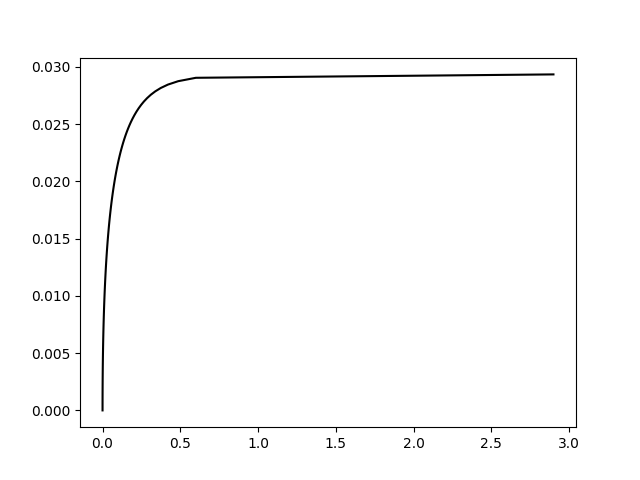
This example demonstrates the final shape of simulated flow using Coussot’s equation.
The frontal lobe shape of the simulated flow at the final step is given by
\[D = - H - \ln(1 - H)\]
- where
\(H\): normalized fluid depth.
\(D\): normalized distance of the front from the origin.
\(H\) and \(D\) are obtained with these expressions:
- with:
\(h\): fluid depth.
\(d\): distance of the front from the origin.
\(g\): gravitational acceleration.
\(\rho\): fluid density.
\(\tau_c\): threshold constraint.
\(\theta\): slope of the surface.
Implementation
First import required packages and define the context. For this example we will use a fluid with a density of \(\rho = 1000 kg/m^3\): and \(\tau_c = 50 Pa\), with a slope of \(\theta = 10°\):
from tilupy.analytic_sol import Coussot_shape
import matplotlib.pyplot as plt

case_1 = Coussot_shape(rho=1000, tau=50, theta=10)
case_1.compute_rheological_test_front_morpho()
plt.plot(case_1.d, case_1.h, color="black")
plt.show()
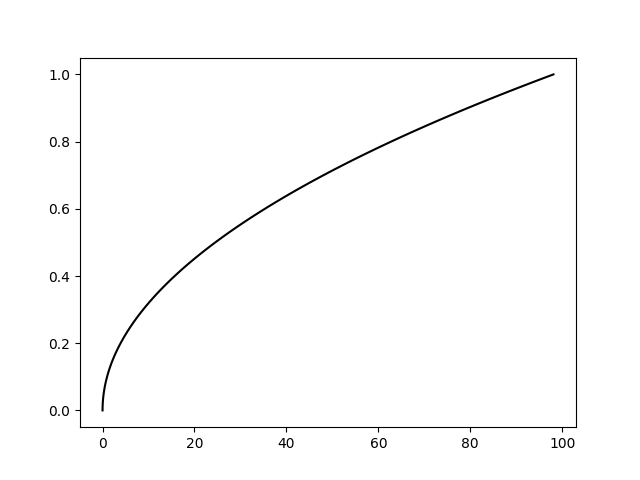
If \(\theta = 0°\), the equations are slightly different:
with:
case_2 = Coussot_shape(rho=1000, tau=50, theta=0, h_final=1)
case_2.compute_rheological_test_front_morpho()
plt.plot(case_2.d, case_2.h, color="black")
plt.show()
Original reference:
Coussot, P., Proust, S., & Ancey, C., 1996, Rheological interpretation of deposits of yield stress fluids, Journal of Non-Newtonian Fluid Mechanics, v. 66(1), p. 55-70, doi:10.1016/0377-0257(96)01474-7.
Total running time of the script: (0 minutes 0.069 seconds)